A story of 3 ships and 3 captains in the Second World War
by John Douglas, Yorkshireman and
ex seafarer.
Background
My father and grandfather were both seamen in the Merchant Navy
at the outset of the Second World War yet neither of them talked much about
their experiences. It was much later that my mother provided some insight to
their exploits in this period.
It started with one document and two photographs: A bound copy of the
London Illustrated News dated
Saturday November 11
th. 1939
(1), an original signed
copy of the German pocket battleship “Deutschland”
(2)and
a photocopy of a newspaper cutting with the caption “Mannen med brillene er
Captein Randall”
(3)!
My mother handed them to me and then gave her version of
events in October 1939 concerning my grandfather, Captain F.G.W. Randall, and
my father Second Officer George Douglas, both on the cargo ship “Stonegate”.
The resulting story is based on my mother’s story and
evidence found in newspapers and documents concerning the early period of the
war.
The setting
War between Britain and Germany was declared 1st.
September 1939 and very quickly Germany started an offensive against British
shipping in the Atlantic sinking almost 30 ships in the first month mostly by U-boats
in the Western Approaches. Against this background three ships and their
captains came to meet in the middle of the Atlantic.
The first ship was the “S.S. Stonegate”, a British tramp ship owned
by Turnbull and Scott and Co., a North Yorkshire family shipping company from
Whitby with a base in London. The ship was built in 1928 of 5044 grt with a 3
cylinder steam reciprocating engine capable of 10 knots.
Most of the officers were recruited from the North Yorkshire
coastal area hence my grandfather from Robin Hoods Bay and my father from
Whitby.
The ship departed Tocopilla near Antofagasta in Chile reportedly
for Alexandria in Egypt with a cargo of nitrates. She left Tocopilla around the
13th. September 1939 heading for Panama and the Atlantic.
The second ship was the German heavy cruiser/pocket battleship
“Deutschland” sent to patrol the North
Atlantic and sink allied shipping. With
a displacement of 12,630 tons her diesel engines gave a maximum speed of 28
knots.
On 24th. August 1939, before the declaration of
war by Britain, she set sail from Wilhelmshaven to establish a position south
of Greenland to intercept Allied merchant shipping. Her orders were to strictly
follow prize rules that required her to stop and search ships for contraband,
evacuate the crews and then sink the ships.
The third ship was the American flag merchant ship “City of Flint”
that at the beginning of the second world war was been operated by the United
States Lines in support of the American Maritime Commission for the American
Army. The ship was of 4963grt with steam turbine propulsion capable of 11.5
knots.
She left New York on the 3rd. October 1939 bound
for the UK with a mixed general cargo including food.
The voyages
The Stonegate left Tocopilla around the 13th.
September, some two weeks after the start of World War Two. With a speed of
around 8 knots
she would transit the Panama Canal and would have cleared the Mona Passage and
entered the North Atlantic around the 29th. September.
The “City of Flint” departed New York for Glasgow and
Liverpool (4)
on the 3rd. October.
The Deutschland left Wilhelmshaven in the Baltic Sea on the
24
th. August some 3 days after the departure of the Admiral Graf
Spee. Their intention was to harry commercial ship traffic in the North and
South Atlantic respectively. Both were accompanied by supply ships, the “Westerwald”
for the Deutschland and the “Altmark” for the Admiral Graf Spee.
Both sailed north up the neutral coast of
Norway and then west and south to their hunting grounds. The Deutschland went
furthest to the west before turning south coming to the east coast of Greenland
before turning south to start its search for ships.
(5)
By the 30th. September she was already midway
between the Azores and Newfoundland (6).
So here is the chart constructed from reported dates and
ship data.
The routes and positions are based on best estimates and
normal navigation practices. For instance it is usual to use the Mona Passage
when entering the Atlantic northbound to Europe from the Caribbean.
Also the normal great circle routes normally followed by
ships are drawn on the chart.
The destination of the Stonegate is unclear at this point
being variously described as Alexandria in Egypt (1) or England. (7) Therefore both the
routes to the Mediterranean and the English Channel are drawn.
So as both the City of Flint and the Stonegate prepared to
transit the North Atlantic, the Deutschland was already positioned in a central
position to intercept them.
The Battle of the Atlantic, as described by Winston
Churchill, had already begun and many ships had been sunk by U-boats in the
Western approaches to the UK and in the North Sea. However the use of heavy
German warships had not yet started but with the Deutschland and her sister
ship Graf Spee already in the Atlantic things were about to change.
At this early stage of the war two important features
impacted the fates of the City of Flint and the Stonegate. Firstly, America was
neutral and did not enter the war until after the attack on Pearl harbour over
one year in the future so the City of Flint was a non-combatant in October 1939
even though she was intended for a destination in the UK.
Secondly, convoy systems had been established shortly after
the war over the Atlantic
and the City of Flint may have intended to join up with an east bound Halifax
convoy. However convoys did not extend to ships coming up from the Caribbean
(8). As a result the
British registered ship Stonegate was alone in her voyage to the UK.
(9)
The Captains
Stonegate
Captain Fred George William Randall
Captain Fred George William Randall
,
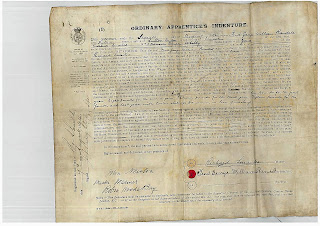
my grandfather, known in the family as “Gramps”, was born in 1879 and started a
life at sea aged 15 in 1894 as an apprentice in small ships registered in
Whitby. He progressed through able seaman
and was granted a Masters Certificate
in 1904 at the age of 25. By this time he had voyaged around the world
especially to South America. By 1939 he was 60 years old with 45 years seagoing
experience, an experienced seaman by any standards.
He married Rachel Anne Emmerson on 13th.
September 1905 in Robin Hoods Bay and they had two children, a boy called Fred
and my mother Rachel Evelyn Randall.


My grandmother and her parents died in 1933-34 leaving Fred
and Evelyn, as she was called, without support as grandfather was at sea. Fred was sent to relatives and mother, now 26
years old, became housekeeper to grandfather and sailed with him on many
voyages around the world. What a life for a young single girl in those days.
Riding a camel in Egypt and picnicking in Argentina was just a couple of her life
experiences.
My mother trained as a pianist and organist aiming for her
LRAM (Licentiate of the Royal Academy of Music) grades but never really came to
further her profession. Instead she played piano and organ at home and as an
accompanist to amateur and professional singers. When she started to travel
with her father, the piano also went on board. Unfortunately it was lost when
the Stonegate sank.
She also met my father at sea and in this picture she has
her father behind her and her future husband, the second mate, on the right
side in the front row.
George Douglas, my father, was born into a fisherman’s
family in Whitby in Yorkshire and turned to the sea as a profession. He joined
my grandfather’s company Turnbull Scott and they sailed together on the
Stonegate and he was the second mate on that voyage in October 1939 as the
entry in his discharge book signifies.
It shows that he joined the ship on the 9th. July
1939 in Sunderland and was discharged “at sea” 5th. October 1939
because that was the date the ship sank. The discharge is signed by the
Captain, my grandfather, and dated 2nd. November 1939 in South
Shields, immediately on their return to the UK. There are no previous records
for my father because his discharge book was presumably lost on the ship with
the piano!
An indication of the state of mind of my grandfather at the
time can be drawn from the fact that he told his daughter to leave the ship in
Amsterdam on the previous voyage as he was afraid that there was going to be a
war. So she was at home alone whilst her father and boyfriend went back to sea
on a voyage to Chile with a world war pending.
So when the Stonegate entered the North Atlantic heading
north alone after the start of the Second World War what was going through his
mind? His ship was fully loaded with nitrate, slow and unarmed. There was no
convoy system and therefore no naval support and he would have no knowledge of
the whereabouts of German warships. However he probably did know that when
approaching the Western Approaches and nearing the UK he could expect U-boat
attacks.
City of Flint
Captain Joseph Aloysius Gainard (10)
Captain
Joseph Aloysius Gainard was born on October 11th. 1889 in Chelsea
Massachusetts. In 1917 he enlisted in the U.S. Naval Reserve Force, aged 28, as
a quartermaster third class and was commissioned as Ensign in 1918. (11)
He saw active duty in the First World War and was aboard the
USS President Lincoln when she was sunk with loss of life by a German submarine
off the Scilly Islands. He spent 5 days in a life raft before been picked up. The
rest of that war he spent in the UK including the transfer of troops to and
from France. He was made Lieutenant in 1920 and honourably discharged from
service in 1925.
He transferred to the merchant marine and whilst master of
the SS Bakersfield in 1929 he was made Lieutenant Commander in the US Naval
Reserve.
When the Second World War started he was again at sea and
went to the rescue of the British passenger ship Athenia owned by the
Anchor-Donaldson line (12). On a voyage from
the UK to Montreal with 1103 passengers she was sunk on the 3rd.
September 1939 by a German U-boat west of Northern Ireland. A number of ships
responded to the distress call from the Athenia including Captain Gainard, now
master of the City of Flint. He picked up 236 survivors and took them to
Halifax, Nova Scotia. The sinking of a passenger ship was illegal and as many
of the passengers were from neutral countries it gained a lot of publicity.
By the time he left New York on his next voyage on the
3rd. October heading back to the UK he was 50 years of age with 22
years seafaring experience. He had been involved in two world wars and
experienced both a sinking and a rescue. He was a modest man; “I’m no hero. All
I claim to be is just a sailor; right now an officer in the United States merchant
marine, once just an officer in the United States Navy.” (13) He was a very
experienced professional seaman.
Deutschland
Captain Paul Werner Wenneker
Captain Paul Werner Wenneker was born in 1890 in Kiel
Germany into a naval family, and in 1909 at the age of 19 became a midshipman
in the German Navy. He joined the cruiser Mainz in 1913 and saw action in the
first naval action of the First World War in August 1914 in the Battle of the
Heligoland Bight in which the Mainz was sunk and Ensign Wenneker was taken
prisoner of war until 1918. In 1919 he returned to the German Navy and served
in torpedo boats taking command in 1920. He had various positions both at sea
and ashore until 1933 when he became Naval Attaché in the German Embassy in
Tokyo, Japan. He was promoted to the rank of contra-admiral and in 1938 he left
Japan to become captain of the pocket battleship Deutschland at the age of 49. (14) He was an
experienced seaman and a diplomat.
The voyages until the 5th. October
The Stonegate proceeded in a north easterly direction and on
the 5th. Of October was in position 31 10N 54 00W indicated by the
yellow symbol below. This position helps us determine her destination as had
she been heading for Alexandria and the Straits of Gibraltar by a great circle
route she would have been much further south and east than her position
indicates. In fact, the position on 5th. October is on the great
circle route from Mona Passage to the English Channel. Although we cannot
discount the possibility that grandpa was taking some “avoiding action” by
taking a more northerly route to the Mediterranean it is most likely he was
following the normal route to the UK.
(9)
On the same date the City of Flint was due south of Halifax,
the rendezvous port, for eastbound convoys. However there is no indication that
she intended to join a convoy and most likely as a neutral ship continued on a
great circle route to the UK. The Deutschland zigzagged south and west until
she found the Stonegate on the 5th. October.
The sinking of the Stonegate (1)
The morning of 5th. October 1939 at sea some 450
nautical miles ESE of Bermuda was cloudy with a heavy sea running. About 11:00
a look-out reported a warship approaching on the port bow. Captain Randall used
his binoculars and quickly confirmed it was a German warship. Quite rapidly a
series of flag signals from the warship commanded the Stonegate to heave to and
not to use their radio. The Stonegate stopped and the warship rounded her stern
and ordered grandpa to abandon ship. A lifeboat from each side was lowered with
all the thirty eight members of the crew of the Stonegate on board. Even though
there was a heavy sea running the lifeboats made good progress as they had the
lever type propulsion system in lieu of oars.

Captain Randall was received with the traditional courtesy of the sea
up the starboard side of the warship and on to the quarterdeck of the warship.
Although he was wearing civilian clothes at the time he returned the salute of
the Captain of the German warship. Then grandpa learnt that the ship was the
pocket battleship Deutschland and its captain was contra-admiral Paul Wenneker.
When all the Stonegate’s crew were safely on board, the Deutschland
approached the Stonegate on the port quarter at a distance of about one quarter
mile and opened fire with her secondary guns. When this did not sink the ship
the main armament was used and the Stonegate sank. The Deutschland then turned
and headed north. Grandpa stated that he and his crew were treated most kindly
whilst on the Deutschland and Captain Wenneker even presented him with a copy
of the London Illustrated News of August 12th.
The interception of the “City of Flint”
After the Stonegate was sunk, the Deutschland headed in a
northerly direction towards the southern point of Greenland. It may be she was
heading to her supply ship that would have been in the supply area marked on
the map (6) south and west of
Greenland to offload her British prisoners of war exactly as the Graf Spee did
with the Altmark in the South Atlantic. (15)

However on the 9th. October in latitude 45.09N longitude
43.22W, some 800 nautical miles north and east from the position of the sinking
of the Stonegate the City of Flint was heading north and east towards the UK.
It was cloudy and dull in the early evening with a moderate sea running when
the lookout reported what seemed to be a fast moving cloud. This quickly was
identified as a warship travelling at high speed that turned out to be a German
warship, the Deutschland. (10) She came up with the
American freighter City of Flint (9) and ordered her to
stop using the same flag sequence as used with the Stonegate. It is worth (9)stating that the City
of Flint was a neutral vessel displaying a large American flag on the side of
the ship. So Captain Wenneker must have known he had stopped a neutral ship.
This act is in accordance with International Law that allows a
warship from a country at war to stop and search ships of a neutral nationality
to check that their cargo is not prohibited. (10) So a boarding party
of 18 German officers and sailors checked the papers of the City of Flint. The
result was that the German officer in charge of the boarding party declared
that the City of Flint was carrying contraband to the enemy. The specific cargo
identified as contraband was lubricating oils and flour. Thus the ship became a
prize of war and a prize crew would take over the ship. At the same time the
Deutschland signalled that 38 English prisoners of war would also be
transferred to the City of Flint on route to a prisoner of war camp in Germany.
Grandpa was given a signed, commemorative picture of the Deutschland by Captain
Wenneker.

So the City of Flint now had a total complement of around 95
seamen, American, German and English. Whilst the German prize crew under
Lieutenant Hans Pussbach were armed and in charge the American crew ran the
ship and the English crew had free use of the ship although it was reported
that the conditions were not as good as on the Deutschland. (1)
Her my mother’s version differs in that she told me that my father
and grandfather were transferred to the SS Altmark which, in fact, was the
supply ship for the sister ship to the Deutschland. At this time she was in the
South Atlantic. However it is an easy slip of the memory as only four months later
in February 1940 the “Altmark incident” in Jøssingfjord in Norway took place
where the Royal Navy attacked the Altmark in neutral Norwegian waters and
released many English prisoners of war captured by the Graf Spee in the South
Atlantic.
Clear evidence that it was the City of Flint can be seen in this
photograph of the crew of the City of Flint presumably given to my grandfather.
The “City of Flint” under a prize crew
So the Deutschland and the City of Flint parted company. The
Deutschland to continue raiding in the North Atlantic and the City of Flint
intending to sail to Hamburg.
On the 14th. October the Deutschland stopped and
sunk by gunfire the Norwegian vessel SS Lorentz W. Hansen on route from New
Brunswick to Liverpool with a cargo of timber. At the time Norway was neutral. The
Norwegian crew were transferred to the Deutschland and then transferred to
another Norwegian vessel, the Kongsdal, on route to Denmark, also neutral at
the time. (16) The resulting
political furore had implications later in the Stonegate incident. This is in
contrast to what happened to the Stonegate crew after transfer to a neutral
ship.
The City of Flint headed “a far northerly course” (1) whilst Norris (10) states that
Lieutenant Pussbach and Captain Gainard took a north easterly course east of
Iceland heading for the northern part of Norway. Clearly the avoidance of
meeting British warships was an important consideration and the ship was
blacked out to make the ship less visible.

However this course is in conflict with reports from Stonegate crew
members in an interview with reporters on arrival in Tromsø. (17) They reported that
between the 9th. October and the 17th. October they
sailed north and the weather became colder and colder with ice and snow on deck
and around the 15th. October they sited 17 icebergs. An examination
of ice charts for August 1939 shows that ice and icebergs only existed west of
Iceland in the Denmark Strait and in towards the Greenland coast. (18) Also it should be
remembered that the Deutschland used this route on its outward leg and
subsequently on its return to Germany. Lieutenant Pussbach would have known
this was a relatively safe route to use.
They arrived in Tromsø on the 20th. October in
the late afternoon some 11 days after leaving the transfer point in the North Atlantic.
This is at least 1 days steaming extra to the direct route east of Iceland. Therefore
it is safe to assume they took the northerly route. Before arrival in Tromsø on
the 17th. October the prize crew overpainted the American flag
symbol on the hull and the flying bridge with a Danish flag and painted out the
ships name and replaced it with the name “Alf”. The reason for this is not
clear but on the 20th. October on approaching Tromsø the ship again
flew the German flag.
Arrival in Tromsø
At this point it is worth reflecting on the fate awaiting
both the crew of the Stonegate and that of the City of Flint. With an intended
destination of Hamburg the crew of the Stonegate would be transferred to a
prisoner of war camp to wait out a war of unknown duration whilst for the
American crew there was at least an uncertain future!
So why did the City of Flint divert into the neutral port of
Tromsø?
International law embedded in The Hague convention (XIII) of
1907 relates to the rights and duties of neutral powers in naval war. (19) Two clauses in that convention
is relevant here, clauses 21 and 22. (19)
Clause 21 states:
” A prize may only be brought into a neutral port on account of unseaworthiness,
Stress of weather, or want of fuel or provisions.” …..
Clause 22 states:
“A neutral Power may allow prizes to enter its ports and roadsteads,”……
Further:
“If the prize is not under convoy, the prize crew are left at liberty.”
Whilst specifically not enabling the release of the
respective crews on the City of Flint it does provide an opportunity to delay
the voyage of the ship and perhaps allow the Norwegian authorities to impound
the ship.
The mechanism used to create this diversion was an apparent
lack of fresh water. Here, again, there are two different versions on how this
came to be.
My mother told me that her father and the other officers
deliberately started to drain the fresh water through the fresh water taps they
had access to. Norris (10) has a slightly
different interpretation. Captain Gainard discussed with his Chief Engineer in
the presence of the English speaking prize crew that they were running low on
fresh water and would need to replenish it although, in fact, they were not low
on water.
Whichever explanation the ruse worked and this initiated the
entry into Tromsø port on the 20th. October.
The Norwegian authorities complied with the letter of the
Hague Convention, topping up the fresh water tanks, restricting any shore leave
for anyone on the ship and ordering it to leave port within 24 hours.
However the crew of the Stonegate were released and the
circumstances surrounding this are not entirely clear. My mother stated that on
boarding the ship the Norwegian authorities asked if there were prisoners of
war on board and the prize crew denied they had any such persons on the ship.
Subsequently, according to my mother’s version, the second officer, my father,
waved a UK merchant navy ensign from a porthole and it was seen by the Norwegian
who returned and released the Stonegate crew. Norris (10) has a different
explanation.
Article 6 of the regulations regarding the crews of enemy
merchant ships captured by a belligerent (20) states:
“The captain, officers, and members of the
crew, when nationals of the enemy State, are not
made prisoners of war, on condition that they
make a formal promise in writing, not to
undertake, while hostilities last, any service
connected with the operations of the war.”
Norris (10) records that
Lieutenant Pussbach made this offer to the Officers and crew of the Stonegate
which they accepted. Reducing the number of persons on the City of Flint may
have been a relief to the German prize crew and certainly was an offer not to
be refused by the Stonegate crew. Therefore they were taken ashore by the
Norwegian authorities.
My mother had a comment that subsequently
the third officer joined another ship after repatriation, was caught again by
the Germans and shot. Both grandpa and my father joined the Royal Naval reserve
and saw out the war as shore based naval officers respectively.
The furore surrounding the City of Flint
and her American crew under a German prize crew continued after they left
Tromsø being a major political issue for both Norway and America. Finally the
Norwegian authorities boarded the vessel in Haugesund and returned the vessel
to its crew and interned the German prize crew.
Repatriation
On release in Tromsø the crew of the
Stonegate were put up in a hotel until the next day when they left in the
coastal ferry “Midnattsol” for Bergen.
En route they arrived in Trondheim on Tuesday 24th.
October and remained on board. A reporter tried to interview the crew but was
politely told by the Captain that there would be no further interviews. This
was after discussion with the British consul in Trondheim and no doubt to
restrict the spreading of war sensitive information.
They continued to Bergen where they were placed in a hotel
awaiting a ship to the UK.
Norris (10) states that the
Washington Post reported on the 30th. October that the Norwegian
steamer “Mira”dropped them off “at an unidentified port on the north east coast
of England that day”.
The Mira was a ferry belonging to the Bergen Steamship company
operating a ferry service between Bergen and the Tyne Commission Quay in North
Shields on the River Tyne close to Newcastle.
This picture
(21) shows the crew
disembarking from the ferry on the River Tyne. The man at the back on the left
is my father.
So by the end of the month of October 1939 my father and
grandfather returned to their homes in Whitby and Robin Hoods Bay respectively
after two and a half weeks in captivity!
There is a twist in the tail of this story. On their return home to Robinhoods bay, Dad tried to enlist again and go to sea in contravention of his signing the Hague Convention not to do so. His discharge book shows he signed on the S.S. Widestone of Turnbull Scotts in South Shields on the 13th. December 1939, some six weeks after returning from Norway. However, he was discharged from that ship in South Shields on the 12th. January 1940 with the comment "R.A","running agreement" that enabled him to return if he desired it.
However, this did not happen as he was drafted into the Royal Naval Reserve to HMS Beaver a shore establishment on the river Humber at Grimsby on the 22nd. February 1940 and married my mother on the 23rd. March 1940 in Cleethorpes with grandfather in attendance. In December 1940, yours truly appeared and another generation started.
Acknowledgements
This article would not have been possible without the assistance of
two family members:
- My mother who gave me the original documents
concerning the Stonegate incident and inscribed the bound copy of the London
Illustrated News covering the incident.
- My brother, Peter Douglas, who is the family
archivist and has done much research on our two families.
- Also Beate Kjørslevik, photographer at the Norwegian Maritime
Museum in Oslo, Norway. She took the battered copy of the London Illustrated
News and scanned the pages relating to the Stonegate incident.
Appendix
The London Illustrated News was a major source of
information in this article. Their special artist Mr. G.H. Davis worked with my
grandfather to create the drawings that were published in the issue of November
18th. 1939.
Bibliography
x
|
1.
|
The Illustrated
London News. 1939 November 11: p. 69-698,706-709.
|
|
2.
|
Postcard of Pocket
Battleship "Deutschland". 1939. Original signed photo given to
Catain Randal by Admiral Wenneker.
|
|
3.
|
Mannen med brillene er Captein Randall. 1939 October 30..
|
|
4.
|
Arbeidersblad O. 1939
Oct 25..
|
|
5.
|
Google Maps, Map data
@2017 Google NEG . [Online].
|
|
6.
|
Roskill SW. Chapter
V! The cruises of the Admiral Graf Spee and Deutschland 1939. In Roskill SW.
The war at Sea 1939-1945. p. Map 11.
|
|
7.
|
Tidene A. 1939 Oct
25..
|
|
8.
|
Hague A.
http://www.convoyweb.org.uk/hague/index.html. [Online].; 2017.
|
|
9.
|
Google Maps, Map data
@2017 Google NEG,. [Online].
|
|
10.
|
Norris AJ. A maelstrom
of International Law and intrigue: the remarkable voyage of the S.S. City of
Flint. Rutgers University. 2013 July 8.
|
|
11.
|
Anon. Naval History
and Heritage Command. [Online].; 2016. Available from: https://www.history.navy.mil/research/library/.
|
|
12.
|
Johnmeyer H. The
sinking of the Athenia. Something about everything military. In.
|
|
13.
|
Gainard J. Yankee
Skipper: The life story of Joseph Gainard, Captain of the City of Flint:
Kessinger Publishing, LLC; 2007.
|
|
14.
|
Chan CP.
http://ww2db.com/. [Online]. Available from: http://ww2db.com/person_bio.php?person_id=87.
|
|
15.
|
Emmerich M. Uckermark
(Altmark in German). [Online].; 2011. Available from: http://www.german-navy.de/kriegsmarine/ships/auxships/uckermark/operations.html.
|
|
16.
|
Michael W. Pocock.
Maritime Quest. [Online].; 2017. Available from: http://www.maritimequest.com/
|
|
17.
|
Tromsø Blad.
"City of Flint". 1939 October 31..
|
|
18.
|
Danish Meteorological
Institute (DMI). Arctic Sea Ice Charts from Danish Meteorological Institute,
1893 - 1956. [Online]. Available from: https://nsidc.org.
|
|
19.
|
The Hague Convetion
(XIII). Full text of "The Hague convention (XIII) of 1907 concerning the
rights and duties of neutral powers in naval war". [Online]. Available
from: https://archive.org/stream/hagueconventionx00inte/hagueconventionx00inte_djvu.txt.
|
|
20.
|
International
Committee of the Red Cross. Treaties, States Parties and Commentaries.
[Online]. Available from: Https://ihl-databases.ircrc.org.
|
|
21.
|
Crew of raider fear
us. Daily Mirror. 1939 October 31.
|
x


