As a seafarer
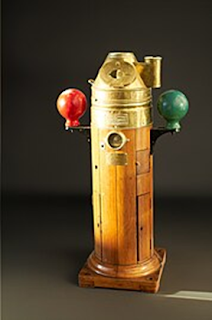
Let us take a closer look at a ships magnetic compass. Today it
is likely to be found on the monkey island as a backup to satnav systems but is
still a requirement on ships.
The compass card is a magnet overlaid with a card holding
the points of the compass. The card has a pivot and is mounted in a bowl filled
with alcohol and water to dampen the movement of the card. The bowl is then
mounted in a set of gimbals so that the
compass remain as horizontal as possible with
the ships motion and the complete magnetic compass is installed in a wooden
stand called a binnacle.
The binnacle provides housing also for important tools to
minimise compass errors.

The first challenge is that the magnetic compass north seeking pole points toward the earth’s magnetic north pole and that is not the same as the true north pole and worse still it is on the move as the image here shows! That means there is a changing error between the true north pole and the magnetic north pole as indicated the magnetic compass. The earth’s magnetic field influences the ships magnetic compass in all places on the planet.
This error is called “variation” and needs to be included in corrections to the


A more complex challenge is based around the fact that steel
ship is also magnetised, and this affects the position of the magnetic compass
north seeking pointer.
It is complex because there are two distinct effects, one by
the permanent magnetism in the ship whose effect does not change with course or
behaviour of the ship and one that is induced by the earth’s magnetic field
that changes the polarity and strength of the ship’s magnetism with course ,
rolling and pitching of the vessel.
This is where the binnacle housing containing the compass
plays a role in minimising the deviation to the compass needle from the ship’s
magnetism.
To minimise the effect of the permanent ship’s magnetism
magnets are placed both fore and aft and athwartship in the binnacle and to
cope with rolling behaviour there is a magnet placed in a swinging bucket
immediately below the compass in the binnacle.

All these adjustments are carried out by a compass adjuster
by “swinging the ship” to determine the deviation of the compass. This produces
a deviation curve which the navigator can use to allow for the deviation of the
compass as well as the variation from the earth’s magnetic field.
As the variation and deviation are measured in degrees west
or east of the compass needle, a mnemonic is a simple way to remember how to
make correction to the magnetic heading.
“These rules are often combined with the
mnemonic "West is best, East is least"; that is to say, add W
declinations when going from True bearings to Magnetic bearings, and subtract E
ones”.[5]
References
‘Binnacle’. In Wikipedia, 2 November 2024.
https://en.wikipedia.org/w/index.php?title=Binnacle&oldid=1254943793.
Cohen, Ofer. ‘Earth’s Magnetic Field
Protects Life on Earth from Radiation, but It Can Move, and the Magnetic Poles
Can Even Flip’. The Conversation, 27 November 2023.
http://theconversation.com/earths-magnetic-field-protects-life-on-earth-from-radiation-but-it-can-move-and-the-magnetic-poles-can-even-flip-216231.
‘Magnetic Declination’. In Wikipedia,
25 September 2024. https://en.wikipedia.org/w/index.php?title=Magnetic_declination&oldid=1247777714.
Nguyen, Van Suong. ‘Calculation of the
Deviation Coefficients for Marine Magnetic Compass’. Journal of
International Maritime Safety, Environmental Affairs, and Shipping 2, no. 2
(8 February 2019): 112–15. https://doi.org/10.1080/25725084.2019.1569336.
Why Do Ships Have
Two Balls?, 2023.
https://www.youtube.com/watch?v=ckhPRie1iKk.
.jpg)

.png)


